
How to Skip the Litigation Line: Protecting Rights to Judicial Reference in California
Judicial reference is a lesser-known alternative to traditional litigation or arbitration in order to resolve contractual disputes, where parties appoint a private referee to decide the case. Best understood as a hybrid of a court trial and arbitration, judicial reference offers several advantages that make it an efficient and often more desirable dispute resolution mechanism.
Commercial disputes in California are expensive, time-consuming, and unpredictable. Jury trials, in particular, carry the risk of large, unforeseeable verdicts. Court calendars in major California counties remain congested. In FY 2023-2024, there were 4.8 million total cases filed with only 2013 judges sitting on the bench.[1] This means judges have an average of 2,430 cases each. During that same time frame over 98,000 unlimited civil cases (cases over $25,000 at issue) were filed in Los Angeles County alone.
While arbitration is often touted as a faster alternative, it introduces its own set of risks. Most notably, arbitrators are not strictly required to follow the law, and judicial review of arbitration awards is very limited. As a result, parties may face decisions that do not follow established law, with little opportunity to correct the decision on appeal.
One mechanism that remains underutilized—and underappreciated—in resolving disputes is judicial reference. This article explains what judicial reference is, how cases are sent to a referee, how it compares to the alternatives, and discusses the frequently raised challenge to judicial reference of waiver.
What is Judicial Reference?
California provides two forms of judicial reference:
Voluntary Reference (General Reference). Under CCP § 638, parties in a lawsuit may agree (raised by stipulation)—or may be contractually bound by a pre-dispute clause—to have a private, neutral third party decide the entire case (raised by motion). The referee is typically a retired judge or experienced attorney. The referee’s decision carries the force of a court judgment and is subject to appellate review. This is the form most commonly found in commercial contracts.
Involuntary Reference (Special Reference). Under CCP § 639, a court may appoint a referee without the parties’ agreement to resolve discrete issues—for example, a complicated accounting, complex discovery disputes, or other matters the court determines are better handled by a specialized neutral. Special reference is a court-initiated tool; it does not require a contractual reference clause.
For voluntary judicial reference, one must consider the goals of litigation and then weigh those against alternatives for resolution.
Voluntary Judicial Reference vs. Court Trial
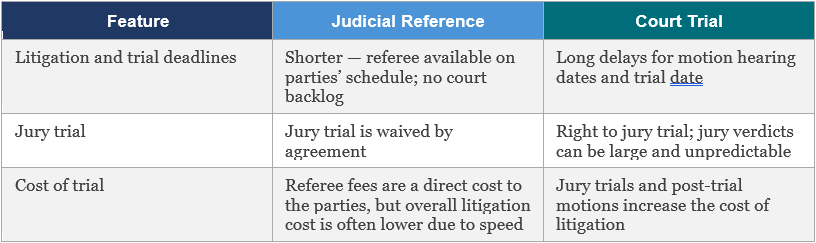
Judicial reference and court trial share similarities, but the outcome timing is different:
Voluntary Judicial Reference vs. Arbitration
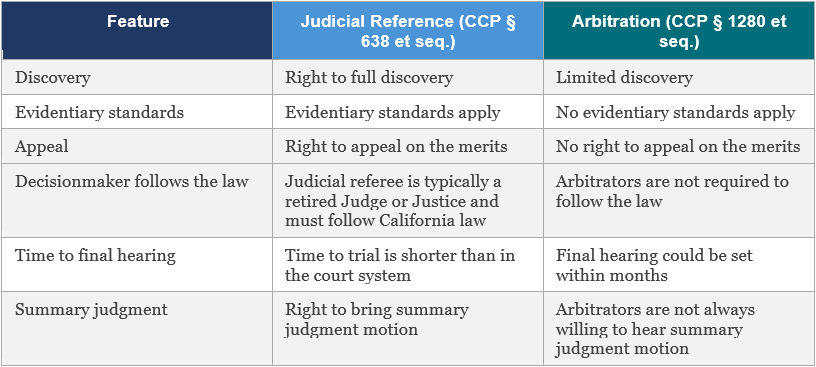
Judicial reference and arbitration are both forms of private dispute resolution, but they differ in important ways:
Preserving the Right to Voluntary Judicial Reference
A party seeking to enforce judicial reference may face challenges if the contractual right is not protected.
One of the most common challenges made is the assertion that a party has waived its right to judicial reference through conduct inconsistent with the intent to have the case heard by a referee.
Courts have determined whether a waiver of a right to seek judicial reference has occurred by looking at various factors:
- Whether the party’s actions are inconsistent with the right to seek judicial reference;
- Whether the litigation machinery has been substantially invoked and the parties were well into preparation of a lawsuit before the party seeking judicial reference notified the opposing party of its intent;
- Whether the party either requested the case be decided by judicial reference close to the trial date or delayed for a long period before seeking a stay;
- Whether a defendant seeking arbitration filed a counterclaim without asking for a stay;
- Whether important intervening steps have taken place, such as taking advantage of judicial discovery procedures not otherwise available, and;
- Whether the delay affected, misled, or prejudiced the opposing party.[2]
California courts have addressed the issue of waiver with increasing emphasis on the high burden for establishing same, emphasizing that waiver is not lightly inferred and typically requires a showing of intentional relinquishment or conduct inconsistent with the assertion of the right.
Judicial reference remains a powerful, though frequently overlooked, tool in effective litigation management. If you would like more information on alternative dispute resolution options, please contact Laura Petrie at Cox, Castle & Nicholson, LLP.
[1] 2025-court-statistics-report_0.pdf
[2] St. Agnes Medical Center v. PacifiCare of California (2003) 31 Cal.4th 1187—analyzing these factors in an arbitration context.
